GT investigates: Who are the mouthpieces of US-led war of public opinion on "Chinese dams' threats" along Mekong River, and what are their typical methods?
GT investigates: Who are the mouthpieces of US-led war of public opinion on "Chinese dams' threats" along Mekong River, and what are their typical methods?
Brewing water conflict
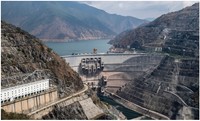
A view of the China-built Xiaowan dam constructed on the upstream Mekong River Photo: VCG
US' politicization of ecological water issues in the Mekong River for the purpose of tarnishing China's reputation via launching rhetoric battles has become more trendy. The Stimson Center, a US-backed think tank, again bashed China in February for allegedly "holding a massive amount of water" and "might need to be paid to release water for downstream communities afflicted by droughts," marking the US' latest efforts to sow discord in the area.
Misrepresentation and biased reports aimed at the dams China has built along the Mekong River have intensified. What's behind it is a long-planned and extensive war of public opinion orchestrated by US officials, think tanks, the media, and activists in support of such actions, the Global Times found out.
With a large investment funneled into the grooming of the mouthpieces of this discourse campaign, the US is trying to turn the Mekong River basin into a new battleground against China similar to the South China Sea.
Who are the typical mouthpieces? What are some of the typical combined tactics they use?
Typical hands in a combination blow
Stimson Center, founded in Washington DC in 1989 and with many members being former and current US government officials, is a key initiator pushing the allegations that Chinese dams are hurting downstream ecology.
In 2019, Brian Eyler, director of the Stimson Center's Southeast Asia Program, published a book entitled Last Days of the Mighty Mekong, in which he attributed various downstream problems - from poor grape harvests, a decrease in tourism, as well as drought in the basin to contaminated drinking water and increased waste in the river - mainly to "harm" caused by Chinese dams upstream.
Publication of the 384-page book marks the beginning of the Stimson Center's intensive assault on China over the Mekong water resources. And the book quickly became the primary "scientific" source for some Western media outlets' biased reports discrediting Chinese dams.
Stimson Center's meddling culminated in the period between November 2019 and April 2020, when the Mekong River was hit by an unexpected drought. With funding from the US-led Lower Mekong Initiative, the Stimson Center, in conjunction with its partner Eyes on Earth, released a report alleging that Chinese dam construction on the upper Mekong hanged the water levels and natural water flow, and the report blamed China for holding back the water, an action that is alleged to have caused the 2019 drought on the lower Mekong.
The Stimson Center further blatantly made some sensational claims against Chinese dams in its article "How China turned off the tap on the Mekong River" in April 2020, smearing that "Chinese policymakers consider water a sovereign resource rather than a shared resource."
Chinese experts, intergovernmental agency Mekong River Commission (MRC), and the Australia-Mekong Partnership for Environmental Resources and Energy Systems (AMPERES) soon pointed out that the report had factual discrepancies with unscientific data selection and too few factors in the model, leading to inaccurate conclusions.
But it did not prevent the premeditated American politicians, such as former US secretary of state Mike Pompeo, and the media from quickly seizing upon and spreading these bits of inconclusive data.
The Global Times found out that an "attack chain" linked to the Stimson Center and Eyes on Earth has been formed to peddle the "Chinese dam threat" over the Mekong River fallacy.
The chain is mainly composed of institutions such as the Human Rights Watch, the International Union for Conservation of Nature, the United States Agency for International Development, and The Asia Foundation, media outlets such as the New York Times and the BBC, as well as some alleged "independent investigative scholars" who live in other countries and regions and distorted the facts by publishing biased opinions.
Some media outlets have developed more innovative ways, such as drawing biting caricatures, in an attempt to smear China's image.
These attacks normally begin amid droughts, which observers said is ideal timing and a perfect hook to exploit their previously constructed false claims against China to the maximum extent.
Another common trick employed in the chain is to escalate ecological water resource issues into social or humanitarian crises, such as alleged dam-triggered droughts which negatively impact food security and even cause unemployment within fishing communities, to further inciting anti-China sentiments among the locals. They can further escalate social problems into political ones, forcing authorities of the the countries that have had cooperation with China on dam projects to make policyadjustments unfavorable to China for the sake of political stability.